
Fields in Grant County Property Tax Records
Two county sources answer two different questions. The Grant County Tax Parcel Portal shows roll entries: owner of record, situs address, mailing address, assessed fields, sale history, and the year selected. The Treasurer's side covers tax bills, receipts, delinquency and redemption accounts, tax-deeded land, and where payments go. Not every parcel card posts a live tax bill. Check the fields on the current record before relying on any figure in a calculation.
| Field | What It Shows | Where |
|---|---|---|
| Roll owner and year | Name shown for the chosen appraisal year | Tax Parcel Portal |
| Assessed land and improvement | Tax value fields, if displayed | Portal / municipal assessor |
| Tax bill and receipt | Levy, amount due, and payment record | Treasurer, portal, phone, or terminal |
| Delinquency and redemption | Account status and redemption information | Responsible Treasurer |
| Use-value, MFL, and PILT | Program change or payment records | Grant County Treasurer |
| Mill rates and tax districts | Rates and taxing-unit context | Treasurer documents and DOR reports |
Assessed value is not the amount due. A tax bill combines that assessment with levies. The levies come from the municipality, school district, county, and other taxing units. The local figure is not interchangeable with a deed's consideration or an appraisal. The Grant County property value question is about what the numbers mean. This page follows how the bill and account are found.
Label every amount before comparing bills. It may be a first installment or a second installment. It could also be the full-year tax, a balance due, or a receipt. The Treasurer warns that the proper payee can differ for some municipal or delinquent accounts. That can happen in December and January. Follow the destination printed on the bill or confirmed by the office. An old payment route from a prior year's receipt may no longer apply.
Ordinary due dates are January 31 for the first installment or full payment. July 31 is the deadline for the second. Those dates alone do not decide how a delinquent account must be paid. The same goes for a municipal account. Confirm the bill year, the receiving office, and any balance before mailing a check. A parcel-card amount is never itself proof of payment.
Read Grant County Tax Years Before Amounts
Tax years overlap in ways that trip people up. A portal year selection is just a search view. It does not promise that the assessed amount, the payment status, and the owner field all refer to the same event. When a new tax year's values are still pending, the portal advises selecting the prior year to see the most current ownership display.
Write down four things with any bill: the appraisal year for the tax year, the bill year, the payment date, and the parcel number. That habit matters most after a sale or a parcel split. The roll has no fixed update schedule. If it still names a prior owner of record, compare the latest recorded deed and ask the Treasurer or assessor which year the field reflects.
Keep the assessment year beside the amount. Keep the bill year beside any levy or payment. When you compare an older tax bill with the current roll, separate a change in assessed value from a change in rates, exemptions, or parcel boundaries. A tax amount alone never explains which part moved.
Find a Grant County Tax Bill Through the Treasurer
The Treasurer offers tax information by phone, at a public-access terminal, and online. The office sits at 111 S. Jefferson Street, P.O. Box 430, Lancaster, and the listed number is 608-723-2604. Have the parcel number, municipality, and tax year handy. Tax and redemption account records there are open to the public. A portal result is a starting point. Confirm any payment or payoff question with the office or the payee printed on the bill.
- Locate the parcel in the Tax Parcel Portal and copy its ID, municipality, and selected appraisal year.
- Use the Treasurer's website, phone, or public terminal to find the bill and payment account.
- Compare prior years and note any use-value, MFL, or PILT entry that applies.
- For delinquency or redemption status, ask the Treasurer which office receives payment for that account.
- Assessed value
- Value assigned by the local assessor for taxation.
- Levy
- Amount a taxing unit raises; the bill also reflects parcel assessment.
- Mill rate
- A rate used with assessed value to compute a tax share.
- Redemption
- A status tied to a delinquent tax account; ask the Treasurer for the current record.
Grant County Tax Information Has Three Access Routes
Web, phone, and terminal give three ways into the same records. That matters when an online bill is missing or a payment route is unclear. Hours run Monday through Thursday, 7:00 a.m. to 4:30 p.m. Friday hours are 7:00 a.m. to noon. Confirm the schedule before visiting.
The Grant County Treasurer page lists public tax access and payment guidance.
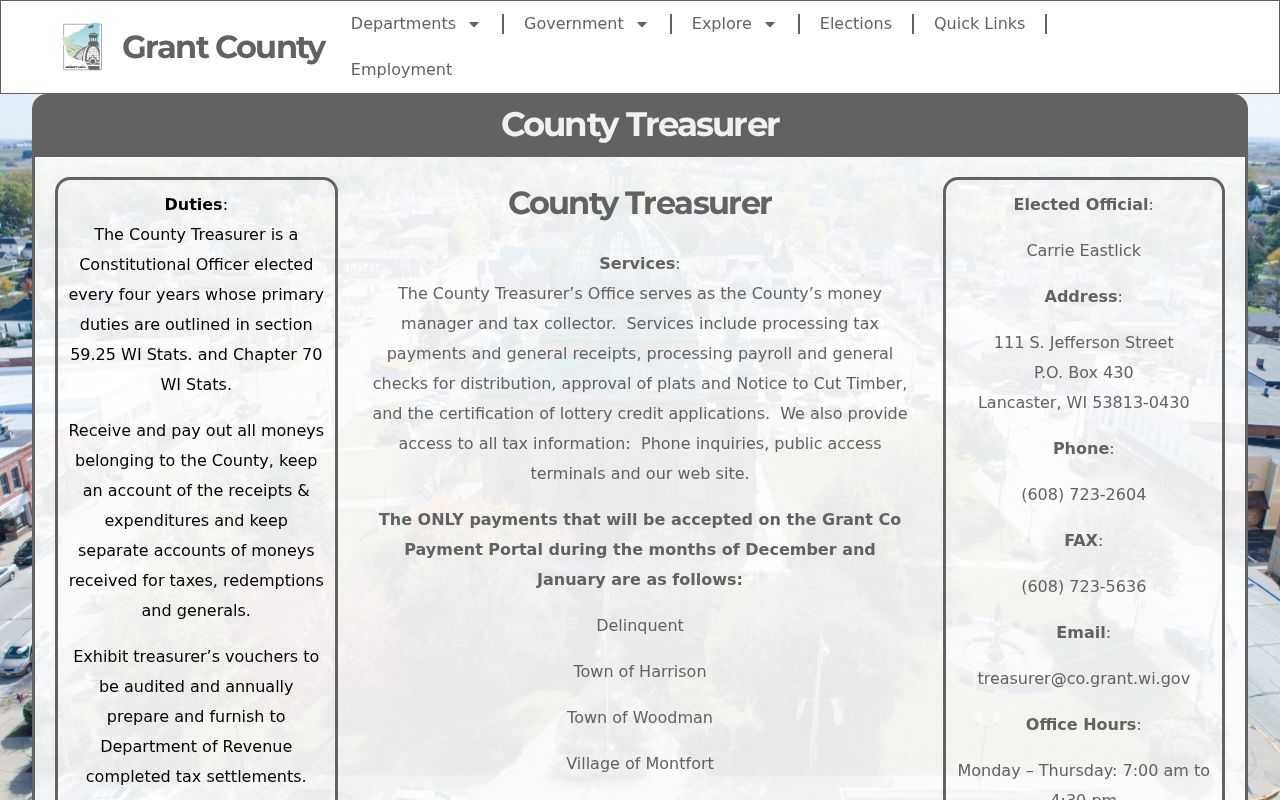
Payment routing shifts for some delinquent or municipal accounts during December and January. First installments and full payments go to the designated Treasurer by January 31. Current second installments are due July 31. Read the bill's payee carefully. Follow the county notice rather than assuming every Grant County account lands at the same counter.
Use-Value and Forest Program Tax Records
Use-value changes run through the Grant County Treasurer's records. So do Managed Forest Law payments and Payments in Lieu of Taxes. Those entries matter. A parcel in a forest or farm program will not be taxed like the home lot next door. When you read these property tax records, keep four things together: the land class, the program, the year, and the payment entry. The county page also posts a 2025 mill-rate document. It adds an Address Change Form, a Road Map to Property Tax Foreclosure, and a 2026 Unredeemed Lands advertisement.
A listing alone proves nothing about eligibility or the full parcel calculation. Bring assessment-class questions to the municipal assessor. Bring account, payment, and redemption questions to the Treasurer. The state Department of Revenue's assessment materials sort out the difference between local assessed value and equalized value. But they never replace the parcel's own tax bill.
Compare Grant County Assessments With DOR Reports
In Wisconsin, local assessors value the individual parcels. The Department of Revenue sits above that work. It calculates equalized values and publishes assessment ratios and levels for each municipality. An assessment ratio compares one parcel's assessed value against its fair-market value, while an assessment level compares total assessed value with equalized value across a whole municipality. The two figures are related. They are not interchangeable. Agricultural, agricultural-forest, and undeveloped land classes also behave differently, so a straight residential comparison can mislead.
The Wisconsin DOR statistical-report page links annual ratio and equalized-value material.
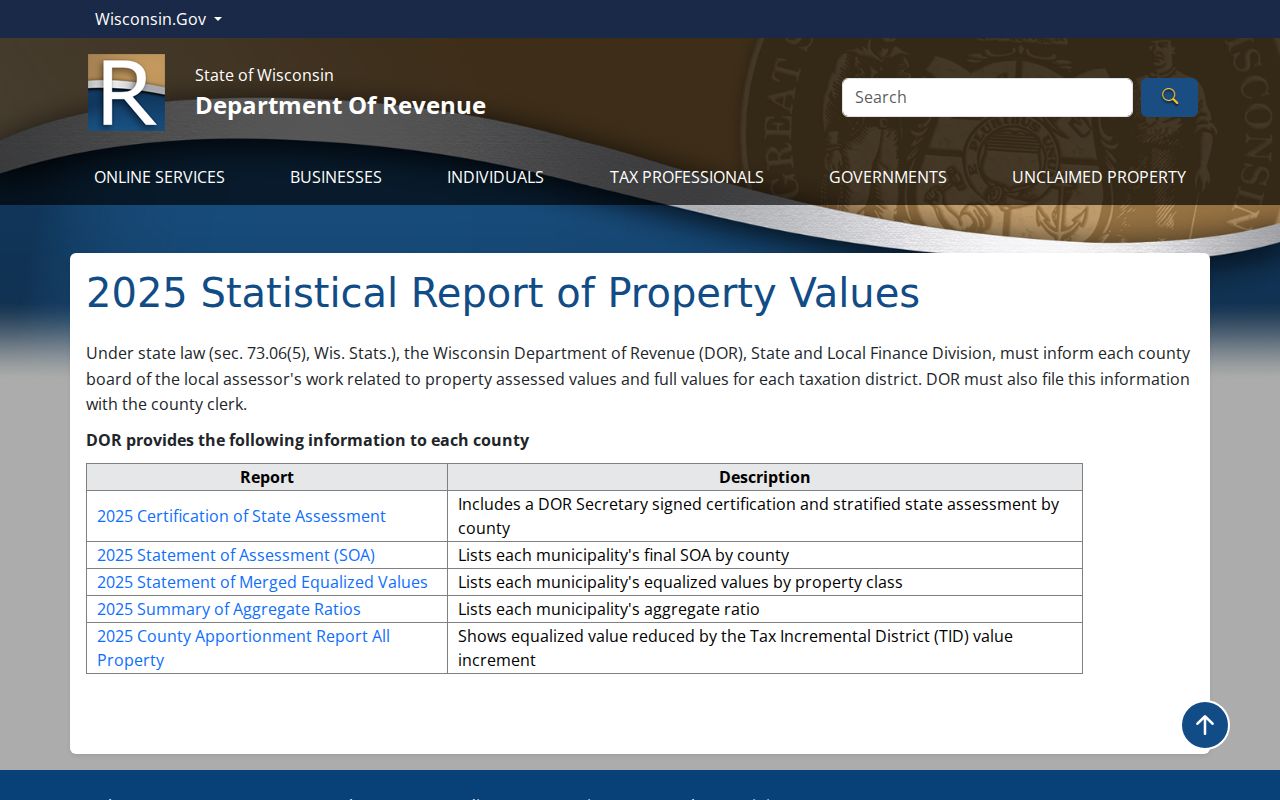
A DOR report gives you a frame of comparison. It does not correct a single assessment. Revaluations in Grant County tie back to a January 1 value date. Think a value looks wrong? Keep the assessment notice and any property facts that back you up. Then turn to the municipal review process and current DOR guidance.
Delinquency and Tax-Deeded Land in Grant County
The Grant County Treasurer's page links a Road Map to Property Tax Foreclosure. It also links a 2026 Unredeemed Lands advertisement. The office acquires, manages, and sells tax-deeded land. One caution applies here. A tax portal status is not a payoff statement and not a final title result. Confirm the balance, payment recipient, and redemption status with the Treasurer. Confirm any later recorded conveyance with the Register of Deeds.
A complete check can pull together the tax card, current and prior tax bills, the redemption account, and the published notice. It can also pull the circuit-court docket, sheriff-sale material, and the recorded foreclosure deed or confirmation. A court event points to a case. The recorded land instrument documents the result. Ask the Clerk of Court for the actual judgment. Ask the Register of Deeds for whatever was recorded afterward.
For tax-deeded property, start with the notice date and the parcel description. Then verify current status with the Treasurer. An old delinquency or an unredeemed-land listing does not establish present availability, redemption rights, or sale terms. If the parcel changed hands since, the deed index may show the later conveyance. The tax notice itself remains historical. Keep every record in chronological order. Ask the offices to confirm which payment destination applies to the account today.
Question a Grant County Assessment Through the Municipality
Assessment in Wisconsin is local. The parcel's municipal assessor and Board of Review handle the individual value question. The Department of Revenue supplies assessor lookup, Board of Review resources, forms, manuals, and ratio reports. Preserve the notice, tax year, parcel number, property class, land and improvement values. Also note any recent sale or physical change. Grant County publishes no countywide filing deadline or calendar. Use the notice and the municipality's current procedure rather than assuming a single date.
Platteville's forms page includes an Objection to Real Property Assessment form. That material is city-facing. Pair it with current municipal Board of Review timing. For other cities and towns, find the correct local assessor first. The Wisconsin DOR assessor hub is the place to start. A tax portal amount alone never shows whether a review request has been filed.
Review timing. Grant County assessment dates depend on the municipality and the notice for the parcel. Confirm the current filing window with the local assessor or Board of Review; no countywide deadline was verified in the source material.