
Grant County Deed Records by Instrument Type
The Register of Deeds records every instrument that affects land in Grant County. Most deeds mark a transfer. Not every one is a standard purchase. The index can hold personal-representative, trustee, transfer-on-death, quitclaim, correction, and tax-related conveyances. Read the signer's capacity first. Check the full legal description before treating a name as the former owner of record, then confirm the available document-type menu in the portal or with the office.
| Deed Type | What It Does | Common Use |
|---|---|---|
| Personal-representative deed | Transfer signed under estate authority | Trace with probate file and recorded description |
| Trustee deed | Transfer by a trustee in that capacity | Preserve the trust name and capacity |
| Transfer-on-death instrument | Names a future transfer path | Check the later recorded instrument |
| Quitclaim deed | Transfers the interest stated in the instrument | Read the exact legal description and parties |
| Correction deed | Corrects or clarifies an earlier instrument | Compare with the filing it references |
| Tax deed / conveyance | May follow tax-deeded land proceedings | Check Treasurer documents and later recording |
Mortgages, easements, assignments, satisfactions, and liens all live in the same Grant County land record system without conveying fee ownership. A release clears one named encumbrance. It proves nothing about the others. Read deed records as instruments in a file, not as a single sale-price line.
Access the Grant County Land Records Portal
The county link opens the Grant County Land Records Web Portal. Its landing screen names Parcel and Permit tabs. A login form follows. A separate county property page tells visitors to use Guest Sign In for tax-parcel data. Guest access covers tax parcels. It may not open every recorded deed image or permit attachment, and the deed-image method, online cutoff, and fee schedule are not published on the portal, so ask the office directly.
The Grant County Land Records Web Portal is the county's starting link for recorded-land research.
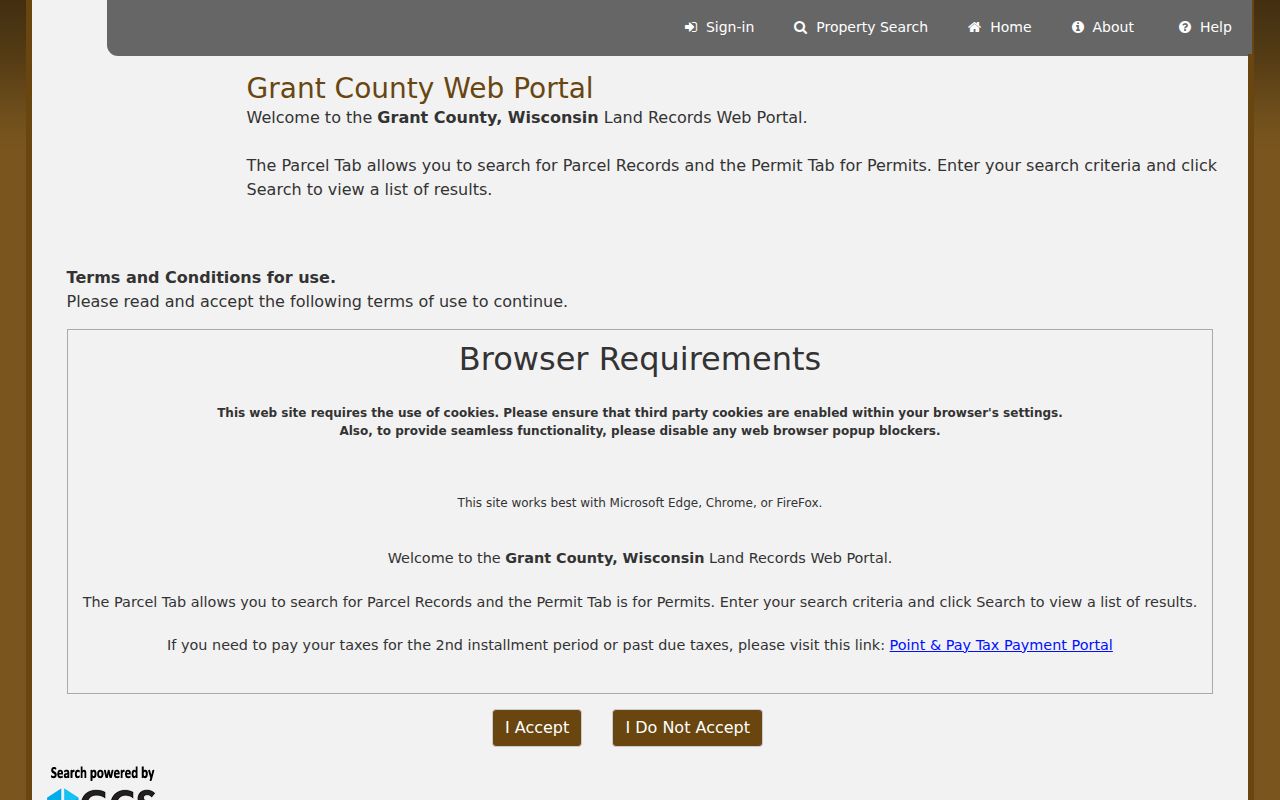
Access sometimes fails online. Call the Register of Deeds at 608-723-2727 or visit 111 S. Jefferson Street in Lancaster. Ask whether a public terminal shows images. Ask whether older books are indexed, and whether plain or certified copies can be supplied. The county notes that older paper, scanned, and office records exist only with confirmation. They must be confirmed with the recorder. That call settles what the portal cannot.
Read the Grant County Grantor-Grantee Chain
The grantor conveys the interest. The grantee receives it. In Grant County, the backward chain starts with the current roll owner, who is likely the grantee named on the vesting deed. Read that grantor. Search it as a grantee in an earlier filing. Carry the legal description and recording reference through each step, and when an instrument names an estate, trustee, or personal representative, follow that capacity rather than assuming a simple buyer-seller chain.
- Identify the current parcel and roll owner, then search the grantee side for the vesting instrument.
- Copy all grantors, grantees, document type, recording date, and book/page or document number.
- Search a prior grantor as grantee and compare the new legal description with the subject tract.
- Repeat until the online index no longer reaches the prior instrument, then ask about paper books or microfilm.
- Grantor
- The party named as transferring the interest.
- Grantee
- The party named as receiving the interest.
- Chain of title
- The linked sequence of recorded instruments for the same land.
- Book and page
- A volume reference; an instrument number is another filing key.
What to Record From a Deed Search
Field labels can change. Treat this as a checklist and verify the live controls. The portal page identifies Parcel and Permit tabs. If party search is available, test the grantee and grantor sides separately. Vary punctuation and middle initials, and narrow by instrument type and date. Use a document number or book-and-page reference whenever a tax card or prior instrument supplies one.
| Party names | Grantor and grantee, including entity or estate capacity |
|---|---|
| Instrument type | Deed, mortgage, release, easement, assignment, lien, plat, or CSM |
| Recording date | Date entered in the public record, not necessarily closing date |
| Reference | Document number, book/page, or image key if supplied |
| Legal description | Lot, tract, survey, or land-grid wording used to confirm continuity |
Grant County's Paper Index Has No Published Cutoff
Where does the online index end? No official source publishes the earliest searchable year. Keep that gap explicit. Ask the Register of Deeds whether earlier names live in grantor and grantee books, tract indexes, deed books, microfilm, scanned volumes, or state archive duplicates. The county dates to 1837. Age alone proves nothing about digitization, and county organization is not evidence that every instrument since then is indexed online.
For an older property history, preserve spelling variants. Keep the parcel's legal description at hand. If the index stops, the office may point you to a volume or film series. Official accounts record no courthouse fire or records-loss episode, so a missing web result is not proof that a record was destroyed.
When an older name search fails, broaden one variable at a time. Drop the middle initial. Try a prior surname, the opposite party role, or a wider date range. Then compare the result against a tract index, book reference, plat, or later instrument. An index entry only points to a document. The full recorded page may carry a legal description or capacity clause that changes how the transaction reads. If the office sends you to a paper book or microfilm, record the volume, page, reel, and image reference so another person can reproduce the search.
The Register of Deeds sits at 111 S. Jefferson Street in Lancaster, with mail to P.O. Box 391, Lancaster, WI 53813. The listed phone is 608-723-2727. Confirm before traveling that the counter can reach your date range and document format. A portal login, a paper index, and a certified-copy process are three distinct routes. A successful index search does not guarantee the scanned image loads in the same session. Plan for the second step.
Use Grant County Plats When Descriptions Change
Plat research matters most when the land itself changed shape. A parent tract gets divided. Lots merge. A street is vacated. A CSM creates child parcels. Each event can branch the deed chain, and the county directory helps by sorting plats, surveys, tie sheets, highway orders, and DOT municipal maps into separate folders.
Whenever a legal description changes, find the plat or CSM first. Note its recording reference. Then match each lot to the current parcel ID. Remember that a subdivision name on a tax card is only an index clue, not proof the modern parcel matches the original lot lines exactly.
City properties with a changed number or street label have another resource. The county's municipal map, dated November 30, 1979, covers Boscobel, Cuba City, Fennimore, Lancaster, and Platteville and can add useful context. The map proves no transfer on its own, though. Confirm any chain through the recorded instruments.
Probate Can Change a Grant County Deed Trail
When an owner dies, the deed trail can shift in several ways. A personal-representative deed, trustee deed, transfer-on-death instrument, or survivorship filing may carry the title forward. The probate file may name heirs, a personal representative, an inventory, or authority to sell. Grant County Register in Probate, at 130 W. Maple Street in Lancaster, handles those files at 608-723-2697. Remember that the recorded instrument confirms land title. A docket entry or a will alone does not complete the deed chain.
For a related court case, Wisconsin Circuit Court Access offers a statewide docket index. The Grant County Clerk of Court explains file procedure for the county. Match the case to the deed by legal description and dates. A death certificate is a separate vital record with eligibility rules under Wisconsin law.
Request a Grant County Deed Copy
A deed copy request works best when it is specific. Bring the parcel ID, the legal description, party names, a likely date range, and any document reference you have to the Register of Deeds. Ask separately about index search, image access, a plain copy, a certified copy, and older-book research. The office publishes no image, copy, or certification fee schedule online, so get the current numbers from the office rather than trusting an old web result or a third-party letter.
Online access may not be available for what you need. In that case, visit the counter, call 608-723-2727, or mail a focused written request to 111 S. Jefferson Street, P.O. Box 391, Lancaster, WI 53813. Name the instrument and the recording period, and state plainly whether you need certification. A deed image is one thing. A title opinion or a full chain search is something else entirely.
Certified copies raise their own questions. Ask which certification format the office offers and whether staff need the instrument number or a complete party-and-date search. For an ordinary research copy, say whether PDF or paper works. No published fee schedule, turnaround guarantee, or online image cutoff exists, so confirm those details directly instead of relying on an outdated price or a figure borrowed from another county. Then keep the returned copy with its index citation.
One caution for a chain review: not every indexed land instrument is a conveyance between buyer and seller. A mortgage, easement, assignment, satisfaction, correction, lien, or release can document or change an interest without moving fee ownership at all. Read the full instrument type, the names and capacities, the effective and recording dates, and the land description. For a release, match the obligation it references. For a corrected deed, compare it against the earlier filing it amends. A one-line search result rarely carries enough context to settle those points.
Recorded, not guaranteed. Grant County deed records show instruments in the public index, not every possible unrecorded claim or interest. A title professional must examine the chain before anyone can rely on clear-title conclusions.